Competitors
Competitors describe Korea Asset In Trust Co., Ltd.'s market in their own filings and calls. These verified passages and visual pages show where their strategies meet, using source documents preserved in Sources.
한국토지신탁 (Korea Real Estate Investment & Trust, "KOREIT") (034830)
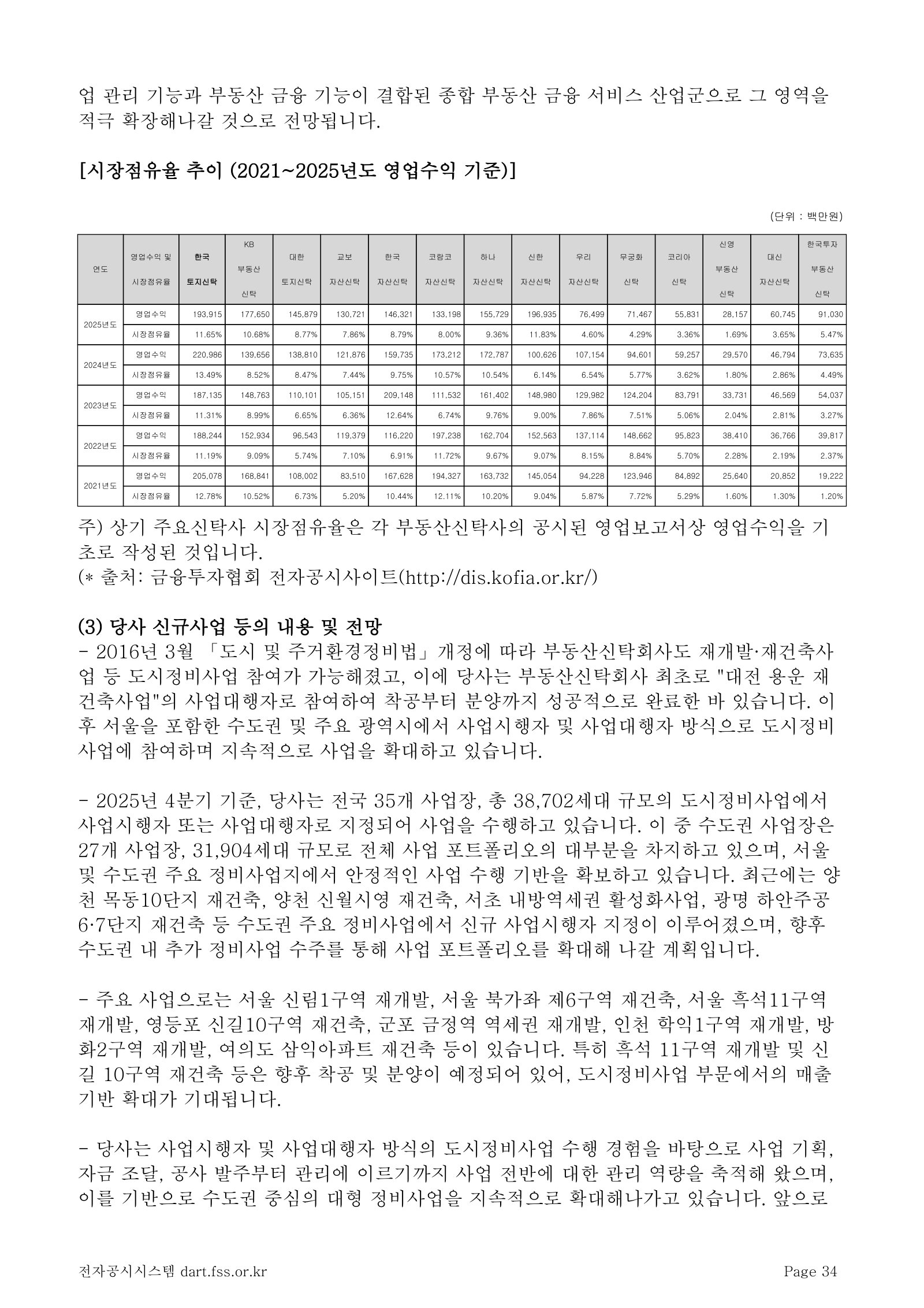
The only other listed pure-play Korean real estate trust company, and the closest thing Korea Asset In Trust has to a mirror. KOREIT holds the same 신탁업 licence from the FSC, sells the same product set - 차입형 and 관리형 토지신탁, 담보신탁, 분양관리신탁, 대리사무 - competes for the same 신탁방식 도시정비 (trust-led redevelopment) mandates, and runs the same kind of REIT AMC alongside it. It was founded in 1996 as a subsidiary of Korea Land Corporation, five years before KAIT, and the two have traded the top of the industry's capital table for years. It matters more than any other document here for a second reason: KOREIT's 사업보고서 is the industry's de facto market-structure report. It reproduces the Korea Financial Investment Association data for all fourteen licensed trust companies - equity, net income, operating revenue, market share - with 한국자산신탁 named in every table. A KAIT reader gets the subject's own share, computed and published by its nearest rival.
코람코자산신탁 (Koramco Asset Trust), disclosed within LF Corp (093050)
Koramco Asset Trust is one of the fourteen licensed Korean real estate trust companies and, on 2025 operating revenue of KRW133.2bn, ranks seventh of the fourteen, two places below the subject. It is the peer whose shape is closest to what KAIT says it is becoming: a trust licence bolted onto a REIT asset-management franchise, with a captive fund manager (코람코자산운용) alongside. It is also the clearest case of a competitor publicly walking away from the business KAIT still leads with - its filing states plainly that it is rebuilding its trust portfolio away from 차입형토지신탁. Koramco is not separately listed; it is consolidated by LF Corp, the fashion group, whose 사업보고서 carries Koramco's standalone business section. Only that section is used here - LF's apparel brands, Maison Kitsune, Max Mara and the rest are set aside as irrelevant to the subject.
Koramco Asset Trust's self-assessment, from the Koramco business section of LF Corp's FY2025 사업보고서 (p.52). Two claims matter to a KAIT reader. First, Koramco describes itself as holding an 과점적 시장지위 - an oligopolistic market position - in REIT asset management for office and retail assets, which is its own characterisation and carries no supporting share figure in the filing. Second, and more concretely, it says it is restructuring its trust portfolio away from a 차입형토지신탁 core toward urban-regeneration work and non-land trusts, and rebuilding its business base for stability. That is a direct strategic divergence: the subject's FY2025 filing still shows about KRW2.2tn of 차입형 land trust inside KRW22.6tn of total assets under trust, and books roughly 60% of its new fee commitments there. One competitor is deliberately reducing the exposure the subject is still writing.
2006년 3월 당사는 부동산신탁업 본인가를 취득하여 리츠 자산관리와 더불어 부동산신탁업 을 겸영함으로써 주택 개발 등의 토지신탁 사업과 분양관리신탁, 대리사무 등의 비토지 상품 들을 수주하여 부동산신탁사업영역을 확대해 왔습니다. […] 나. 당사의 강점 및 단점 당사는 우수한 운용 성과와 영업 네트워크에 기반해 REITs 설립·운용의 전 과정에서 차별적 인 사업 경쟁력을 시현하며 REITs AMC로서 우수한 시장지위가 유지되고 있습니다. 특히, 오피스·리테일 자산을 취급하는 REITs AMC부문에서 과점적 시장지위를 확보하고 있으며, 신규 REITs 설립을 통해 최상위의 영업력을 유지하고 있습니다. 부동산신탁업 또한 부동산 산업에 대한 높은 이해도와 전문성을 갖춘 전문 인력을 바탕으로 운영하는 중입니다. 신탁사업 사업포트폴리오를 기존 차입형토지신탁 중심에서 도시재생사 업, 비토지신탁 등 비차입형 토지신탁을 중심으로 개편하고 있으며, 수익과 안정적인 운영을 위한 사업기반을 재구축하고 있습니다.
p. 52 · Read in context →
Koramco's revenue by product line and its assets under trust, three years, from LF Corp's FY2025 사업보고서 (p.59); columns run 2025 / 2024 / 2023 throughout and amounts are KRW millions. The first block is the foot of the revenue-by-line table that begins on p.58, so its 자산관리 수수료 and 토지신탁 rows sit on the previous page; the total is what matters - KRW82.2bn in 2025 against KRW141.3bn in 2024. Essentially all of the swing is the REIT asset-management fee line reproduced beneath it, KRW58.2bn against KRW119.2bn, which is transaction-driven (acquisition and disposition fees) rather than recurring. The trust table underneath shows the structural point: assets under trust grew to KRW17.5tn from KRW8.9tn in 2023, but the fee take on them fell to KRW17.8bn from KRW19.1bn. Almost all the growth is 담보신탁 - collateral trust - at KRW12.8tn of trust principal earning KRW6.0bn, while 토지신탁 at KRW2.7tn earned KRW10.1bn. That is the ratio that explains why assets under trust is a poor proxy for revenue in this industry, and it is worth holding against the subject's headline KRW22.6tn: the mix inside the number does more work than the number.
관리신탁 132 126 61 처분신탁 872 272 64 담보신탁 5,957 4,103 3,873 분양관리신탁 461 215 190 기타 348 173 179 대리사무 6,229 5,064 3,585 합계 82,242 141,325 75,853 […] 자산관리 수수료 58,170 119,187 53,172 […] 토지신탁 2,659,370 10,073 2,292,043 12,185 2,234,797 14,729 관리신탁 477,624 132 190,106 126 279,846 61 처분신탁 836,640 872 442,899 272 446,489 64 담보신탁 12,777,315 5,957 10,445,901 4,103 5,533,083 3,873 분양관리신탁 791,180 461 811,360 215 407,403 190 기타보수 - 348 - 173 - 179 합계 17,542,129 17,843 14,182,309 17,074 8,901,618 19,096
p. 59 · Read in context →
Koramco's published fee card for REIT asset management, from LF Corp's FY2025 사업보고서 (p.55): 0.5%-1.0% of the purchase price on acquisition, 0.1%-0.3% of assets under management annually, 0.5%-1.0% of the sale price as a base disposition fee, and a performance fee of 10.0%-20.0% of the disposition gain. These are stated ranges, not realised rates, and the filing gives no indication of where inside them Koramco actually prices. They are still the most concrete public benchmark available for the economics of the Korean REIT AMC business, which is one of the ancillary lines the subject runs alongside its trust licence (KAIT holds both REITs AMC and PFV AMC mandates). The shape of the schedule also explains Koramco's own revenue volatility in the exhibit above: two of the four fee events happen only when an asset is bought or sold.
1) 리츠(REITs) 자산관리회사(AMC) 업무 다수의 투자자로부터 자금을 모집하여 부동산 또는 부동산과 관련된 유가증권에 투자·운용 하여 발생한 수익을 투자자들에게 배당하는 부동산 간접투자방식입니다. […] <보수산정기준> 수수료 구분 기준가액 보수율 비고 매입 매입가 0.5% ~ 1.0% 매입시점 수취 운영 운영자산 0.1% ~ 0.3% 연간 수취 매각 기본 매각가액 0.5% ~ 1.0% 매각시점 수취 매각 성과 매각차익 10.0% ~ 20.0% 기타 - - 자문 수수료 등
p. 55 · Read in context →
하나금융지주 (Hana Financial Group) (086790)
Hana Financial Group owns 하나자산신탁 (Hana Asset Trust), which on 2025 operating revenue of KRW155.7bn and 9.36% share ranks just above the subject in the industry table, and which KAIT's own filing shows as the most fee-productive trust company in Korea after KB - KRW104.1bn of fee income from 193 staff. Only the trust-adjacent parts of these calls are used: Hana's banking, cards, securities and insurance businesses do not compete with the subject. What the transcripts give that no annual report does is a lender's running commentary on the real-estate project-finance cycle that sets the subject's environment - the same PF market whose contraction drives 신탁계정대 recoveries, developer defaults and the pace at which new development trusts get written. Hana is also the only peer here that holds live earnings calls with analyst Q&A.
The most recent read available in this document set: Hana's Group CRO on the Q1 2026 call, 24 April 2026, identifying alternative investments and real estate project financing as what group credit cost actually consists of. Less of it was recognised in Q1, which flattered the quarter, and he expects more in Q2, with full-year guidance of a mid-30bp credit cost ratio. Six months after the Q3 2025 comment above, the real-estate PF clean-up is still the swing item in a major Korean financial group's provisioning - a useful check on any assumption that the development-credit cycle the subject operates in has already turned.
['Jae Shin Kang (Group CRO, Hana Financial Group)']: And then, usually, when we talk about credit cost, it is about alternative investments or real estate project financing. We had less of that recognized in Q1 which was a positive factor in credit cost in Q1. We do see that they could increase in Q2. So, our plan until end of this year is mid-30 bp credit cost ratio, that's our guidance.
p. 6 · Read in context →
SK디앤디 (SK D&D) (210980)
SK D&D competes with the subject on two fronts rather than head to head across the whole business. Its subsidiary 디앤디인베스트먼트 is a REIT asset-management company licensed under the same 부동산투자회사법 as KAIT's REITs AMC, and it claims the number-one position in Korea by residential AUM. And as a developer that originates, funds and sells its own projects through REITs and funds, it is the alternative route for exactly the sponsors a trust company wants as 위탁자 - a developer who can assemble the site, the capital and the exit in-house has less need to hand the project to a 차입형 trust. Its filing is also the best sizing in this document set of the institutional rental-housing market (기업형 임대주택), which the subject names as one of its stated expansion areas. Its furniture business and the demerged renewables arm are set aside.
SK D&D's description of its REIT asset manager, from its FY2025 사업보고서 (p.28). D&D Investment claims cumulative AUM of KRW5tn including KRW1.6tn of residential assets, and states it holds the number-one position in Korea by residential asset AUM - the company's own claim, with no source or ranking body cited, and 'cumulative' AUM is a gross lifetime figure rather than a current balance. The listed assets run across rental housing (the Episode brand), offices, a Jeju hotel and logistics centres. The relevance to KAIT is scale in the adjacent business: the subject runs a REITs AMC and a PFV AMC as ancillary lines to its trust licence, and the competing platforms here are vertically integrated - development, asset management and property management under one owner - rather than fee-for-service.
[ 디앤디인베스트먼트㈜ ] 디앤디인베스트먼트㈜는 부동산투자회사법상 자산관리회사(REIT's AMC)로서 1.6조원의 주 거시설 자산을 포함한 누적 AUM(Asset Under Management) 5조원의 성과를달성하였으며, 국내 주거시설 자산 운용규모 1위의 실적을 보유하고 있습니다. 상품기획, 인허가관리, 설계 /시공관리, 운영관리, 매각전략 수립 등 One Stop 개발관리ㆍ자산운용 체계를 갖추고 있으 며, 다양한 투자 파트너십으로부터 최적의 투자구조를 수립하여 운용자산의 통합적인 프로 젝트 관리 및 자산운용을 수행할 수 있는 VerticalPlatform을 보유하고 있습니다. […] 2018년 12월 Episode 수유 838을 시작으로 Episode 신촌 369, Episode 서초 393, Episode 강남 262 등 임대주택 자산을 비롯하여 세미콜론 수송, 세미콜론 문래, 세미콜론 명 동, 서울역 오피스, 여의도 태영빌딩 등의 업무시설과 제주조선호텔, 백암물류센터, 남청라 물류센터, 방배동 시니어 등에 이르기까지 다양한 운용자산을 보유하며 안정적 투자 포트폴 리오를 구축하고 있습니다.
p. 28 · Read in context →
SK D&D's sizing of the Korean rental-housing market, from its FY2025 사업보고서 (p.45). Monthly-rent (월세) contracts passed 60% of Seoul lease transactions in 2024 and reached 65.9% by September 2025 as the 전세 deposit system unwinds; single-person households rose from 30.2% of the total in 2019 to 36.1% in 2024, with one- and two-person households projected at 72.4% by 2040. SK D&D's argument is that the private rental market, historically owned and run by individual landlords, is converting to an institutional 기업형 임대주택 model, and it points to Japan - where individuals own about 85% of rental housing but corporate operators run about 80% of it - as the template. The projections are government statistics as cited by SK D&D; the Japan analogy is its own framing. This is the market the subject lists among its expansion areas alongside urban redevelopment and REITs, described here by a company that has already built more than 6,000 units of operating stock in it.
주거용 부동산은 2023년 12월 국내 부동산 거래현황(도심 건축물 기준)에서 73%를 차지하며 , 이는 상업용 부동산의 약 6.1배에 육박합니다. 공급측면에서 주택사업은 분양과 임대의 두 가지 형태로 나뉘며, 임대주택은 전세와 월세로 구분할 수 있습니다. 전세 제도는 세계적으 로 유일한 국내 특유의 계약 구조로, 최근 몇 년간 시장 환경 변화로 인해 월세 전환이 가속 화되고 있습니다. 서울 전월세 거래에서 월세가 차지하는 비중은 2024년 60%를 넘어선 이 후 2025년 9월 기준 65.9%를 기록하며 지속적으로 증가하는 추세를 보이고 있습니다. 또한, 국가데이터처에 따르면 1인 가구의 비중은 2019년 30.2%에서 2024년 36.1%로 꾸준히 증가 하며, 소형 임대주택 수요를 견인하고 있습니다. […] ② 성장성 국내 임대주택 사업은 공공영역과 민간영역으로 구분됩니다. 민간 임대시장은 그동안 대부 분 개인 임대사업자 중심으로 운영되어 왔으나, 안정적 공급 및 전문적인 운영 필요성이 증 가함에 따라 기업형 임대주택 시장으로의 전환이 점점 가속화되고 있습니다. 최근 글로벌 IB및 주요 외국계 기업의 국내 임대주택 시장 진출이 활발해지면서, 기업형 임대주택 사업의 성장 가능성이 더욱 확대되고 있습니다. 실제로, 부동산 패러다임이 유사한 일본에서는 전체 임대주택 중 약 85%를 개인이 소유하고 있지만, 이 중 80% 가량을 기업형 임대주택사업자 가 운영하고 있으며, 국내에서도 이와 유사한 변화가 생길 것으로 예상됩니다.
p. 45 · Read in context →
More peer documents
한국토지신탁 (KOREIT) - FY2024 사업보고서 — FY2024 · 302 pages · p.30 is the same fourteen-company table one year earlier, which makes the year-on-year moves visible - 신한자산신탁 at negative KRW308.6bn, 교보자산신탁 at negative KRW240.9bn, 무궁화신탁 at negative KRW119.8bn and KB부동산신탁 at negative KRW113.3bn net income in 2024, the losses behind the industry's aggregate operating deficit, with 한국자산신탁 one of eight of the fourteen still in profit that year at KRW16.5bn; pp.29-30 also carry KOREIT's own framing of what the trust market is. · Open →
LF Corp - FY2024 사업보고서 (코람코자산신탁 sections) — FY2024 · 363 pages · p.55 extends Koramco's revenue-by-line table back to 2022, when REIT asset-management fees were about KRW110bn - which shows the KRW119.2bn 2024 figure was not a one-off spike and makes the drop to KRW58.2bn in 2025 a genuine break rather than mean reversion. · Open →
SK디앤디 (SK D&D) - FY2024 사업보고서 — FY2024 · 555 pages · p.30 puts SK D&D's operating rental-housing stock at about 4,014 units at end-2024, against more than 6,000 a year later - the growth rate of the institutional rental platform the subject says it wants to expand into. · Open →
Hana Financial Group - Q3 2025 earnings call transcript — Q3 FY2025 · 13 pages · p.8 has Hana Bank's CFO on the composition of IB fee income: real estate is taking a smaller share of loan-arrangement fees while acquisition finance fills the gap - a lender's read on shrinking development-finance volume, which is the origination pool for new development trusts. · Open →
Hana Financial Group - FY2025 earnings call transcript — FY2025 · 18 pages · pp.15-16 continue past the exhibit with the Group CFO on non-banking capital allocation - KRW14.5tn of invested capital contributing only about 12% of group net income, and a decision to stop injecting capital beyond regulatory minimums - the funding backdrop for a top-three trust competitor. · Open →